State College Borough Council on Monday approved an ordinance that formally prohibits municipal employees from participating in or providing borough resources for civil immigration enforcement without a judicial warrant.
The 7-0 vote — which followed 90 minutes of discussion during most of which anti-ICE protesters could be heard chanting and yelling outside the municipal building — was met with applause within the crowded council chambers. It came after months of urging by residents and immigrant rights organizations and a pledge by members of the borough’s governing body to develop a legally sound ordinance spelling out the borough’s position of noninvolvement.
In practice, the “Welcoming Community” measure changes little for the borough. Rather, it legally codifies policies and resolutions dating back about decade that already limited cooperation by police and other employees with U.S. Immigration and Customs Enforcement operations in State College.
Some local immigration groups alleged a borough police vehicle was present at one ICE operation in March and that agents went to the department’s parking lot “for protection and assistance” after being confronted by residents during enforcement activity in late June, but State College officials have denied any involvement in either incident.
State College joins multiple other Pennsylvania municipalities in formalizing its policies of not participating in immigration enforcement. Council President Evan Myers, who co-drafted the ordinance with Borough Manager Tom Fountaine, said it is based on those in places like Carlisle and Erie, as well as input from residents, including members of the immigrant community, and groups like the Centre County Rapid Response Network.
With its passage, Myers said the borough “will make legal our commitment to protect our immigrant residents of State College from the thuggish behaviors of the [Trump] administration and in particular, ICE and other agencies that put them in danger.”
Discussions of an ordinance came after a proposed resolution in February calling for ICE reform was tabled in large part because the two immigrant members of council, Gopal Balachandran and Nalini Krishnankutty, raised concerns it could bring unwanted attention and harm to the people it meant to support, particularly without substantive action to support it.
“The ordinance does so many of the things that I found lacking in the earlier resolution, and I am pleased to give it my support,” Balachandran said during his 15 minutes of prepared remarks. “I really appreciate how members of this council were trying to protect people like me. And yet, the earlier resolution was drafted and put forward by non-immigrants and folks who have no experience in working with immigrant communities or immigration law. No one consulted immigrants or immigrants’ rights organizations as to whether such a resolution should be put forward.”
Speaking during public comment, Rev. Tracy Sprowls of the Rapid Response Network, who has regularly advocated for an immigrant protection ordinance, said she recognized the borough cannot stop ICE from carrying out operations, but that adopting the measure will help immigrants in the local community feel safer.
“The last weekend in June ICE was in Centre County,” Sprowls said. “They went after people on Allen Street and some of the [resident] responders that are here were there. I was there. They were in Bellefonte and the people were terrified, but that we showed up helped them feel better, and I know, and they have told us, that having an ordinance would help them feel better. I am delivering groceries to two families who are afraid to leave their house. The fathers were taken in Bellefonte. So an ordinance won’t help them, but it will help people in our community.”
WHAT THE ORDINANCE DOES AND DOESN’T DO
The ordinance was prepared in consultation with legal counsel and includes what was determined to be legally defensible.
“We believe that they sustain the borough’s obligation and responsibility for enforcement of criminal actions, criminal laws both here in Pennsylvania as well as actions that may be violations of federal law that we have a responsibility to address, while continuing the longstanding, almost 10-year policy on not being involved in any way, shape or form, or having any communication on the enforcement and actions related to civil immigration actions,” Fountaine said.
Specifically, it prohibits borough employees “except where required by federal law, state law, court order or judicial warrant,” from participating in, assisting, supporting or providing resources for civil immigration enforcement, and from interrogating, investigating or questioning anyone for the purpose of determining immigration status.
Borough employees may not honor immigration detainer requests or administrative warrants, or requests for voluntary transfer or notification, and cannot provide advance notice of a person’s release date, custody status, home address, work address, school location or other contact information for the purpose of civil immigration enforcement.
State College also cannot enter into 287(g) agreements, a program that provides incentives to local law enforcement who accept the delegation of certain responsibilities for immigration enforcement.
The ordinance further prohibits granting federal immigration enforcement officials access to non-public borough facilities, databases or equipment unless a valid judicial warrant is issued.
It additionally aims to ensure equal access to borough services. Borough employees cannot inquire about or record an individual’s immigration status unless it is directly relevant to determining eligibility for a specific service, benefit or public employment as required by federal or state law. Any question about citizenship or immigration status not required by law will be removed from forms used by the borough, and “presentation of foreign identification shall not subject an individual to greater scrutiny or different treatment than would apply to a person presenting identification issued by a United States jurisdiction.”
It explicitly does not prohibit compliance with federal or state law, or compliance with a judicial warrant, and does not limit cooperation with federal authorities in connection with
criminal investigations. Fountaine noted that State College police have and will continue to cooperate with the broader Department of Homeland Security, of which ICE is a part, and other federal agencies on criminal investigations.
The ordinance also does not limit emergency assistance necessary to protect life or public safety, nor does it authorize interference with federal operations.
It does not define specific sanctions for employees who violate the provisions of the ordinance. Fountaine said personnel disciplinary issues are a matter for borough management, as the home-rule charter prohibits council from regulating individual employees.
“I would have to take action as a personnel matter, and if I failed to do that, you can take action against me,” Fountaine said in response to a question about ordinance enforcement.
The ordinance does not include some measures Myers said he and others would have liked to include, like prohibiting federal agents from wearing masks while operating in State College. A federal judge recently blocked Philadelphia from enforcing a similar measure, ruling that a city cannot regulate how federal law enforcement conducts its operations.
Instead, a separate resolution approved by council as a “statement of principles regarding immigration enforcement, public safety and constitutional rights” includes an encouragement for federal agents “to avoid the use of face coverings that prevent public identification except where reasonably necessary for legitimate safety, medical or operational reasons.”
The other principles of the resolution, which was adopted immediately after the ordinance, include:
- Public safety is strengthened when all persons may report crimes, seek emergency assistance, attend public meetings, access municipal services, and participate in civic life
without fear. - The Borough affirms its commitment to the First, Fourth, Fifth, Sixth, and Fourteenth Amendments to the United States Constitution and to the equal protection of all persons under law.
- The Borough supports lawful law enforcement conducted in a manner consistent with due process, transparency, accountability, and respect for human dignity.
- The Borough encourages federal officers to avoid the use of face coverings that prevent public identification except where reasonably necessary for legitimate safety, medical, or
operational reasons. - The Borough encourages all governmental agencies to minimize unnecessary disruption to schools, institutions of higher education, houses of worship, health-care facilities,
libraries, community centers, and similar public-serving institutions. - The Borough encourages federal agencies to maintain transparent procedures for receiving complaints, reviewing use-of-force incidents, and responding to allegations of
constitutional violations. - The Borough affirms that public safety, transparency, constitutional rights, and effective law enforcement are mutually reinforcing principles.
The final statement of the resolution notes that it is “aspirational and advisory only.” For that reason, council member John Hayes was the lone no vote, saying that he promised to “bring pragmatism and productivity” to his role on council and does not believe in “messaging bills.”
Resident Sylus Smith, however, said the resolution is important because it reassures the public “that this council does believe in the human rights of immigrants; it does believe in its responsibility to protect every member of this community so that State College can be a place for everyone.”
“I think you can also take it as a call to action for yourselves individually,” Smith said. “Too often we have politicians who seem to believe that their responsibilities begin and end with speeches and a vote. Too often they forget that as members of this community with such a high standing and with such connections to various organizations, they can be part of bringing us all together and organizing us so that we can make more meaningful actions against injustices like this one, such as by lobbying more effectively our state government and all sorts of manners in which we can bring the community together to demonstrate the power of the people in this community. So I think you will find that is a little more than purely worthless symbolism.”
Smith was among about a dozen people who spoke during public comment, all but one of whom favored the ordinance and resolution. One community member urged council to vote no on the ordinance for “the safety and security of the State College area,” saying that “ICE is only trying to do their jobs.”
Krishnankutty, meanwhile, called on her fellow council members to consider the ordinance and resolution one step in an ongoing effort.
“Our work is not done,” she said. “If we pass this ordinance today, is everything going to stop? And so I urge all of us to figure out, what can we do at the county level? What can we do at the state level? What can we do at the federal level? And collectively, all of us, get there. What can we do at the ballot box right? All of it.
“This is a step, but I don’t think we can rest on it because our powers are very limited. And I look at this as us continuing to do the policies that we already had, but kind of providing clarity both to our residents, to ourselves, to the staff.”
PROTESTORS TAKE TO THE STREET, MARCH TO MUNICIPAL BUILDING
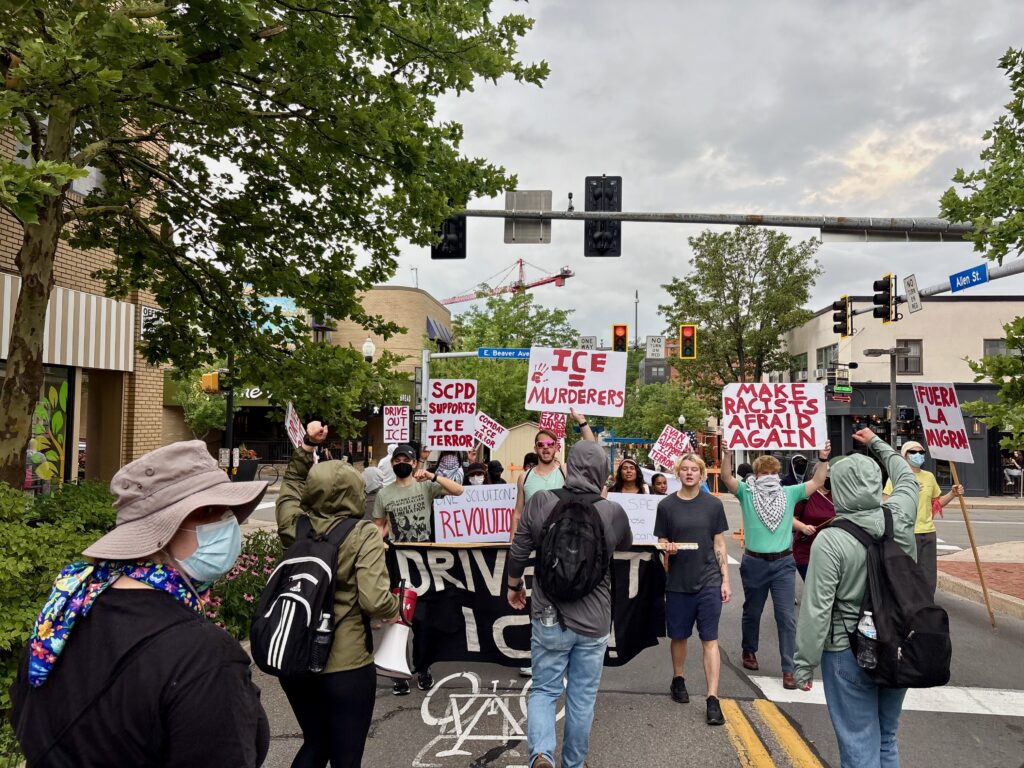
About 30 demonstrators marched through downtown State College on Monday evening ahead of the meeting as they called on council to adopt the ordinance prohibiting collaboration with ICE.
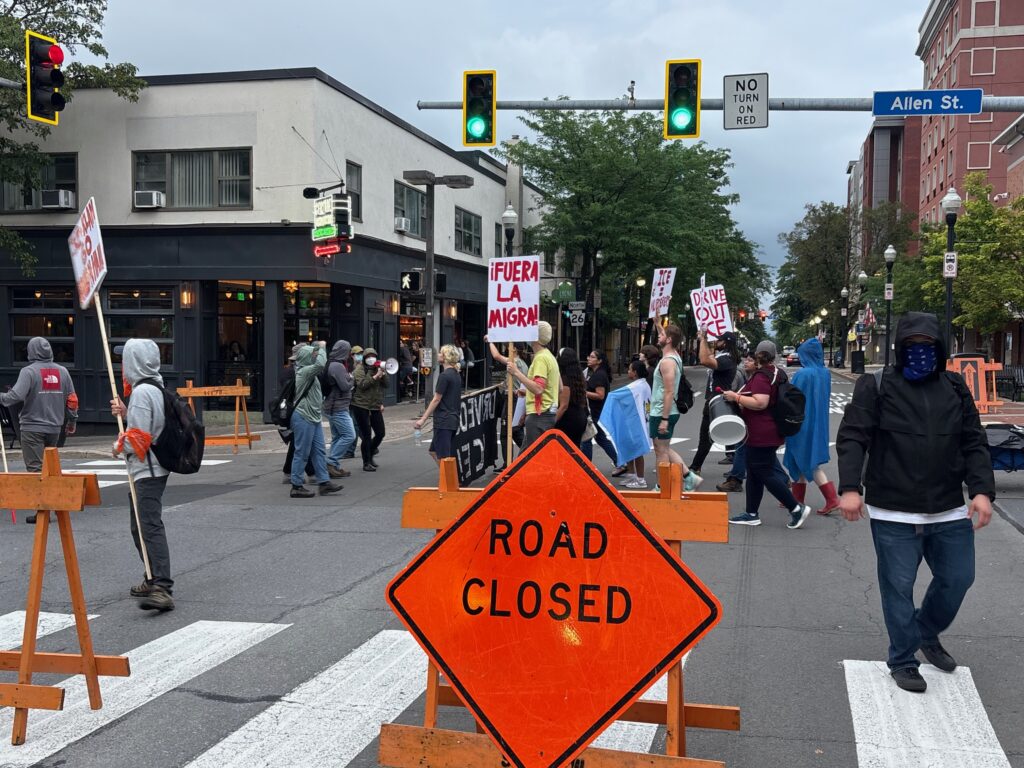
The protest, organized by People’s Defense Front, began around 6:30 p.m. at the Allen Street Gates before participants briefly stopped traffic on College Avenue and marched west.
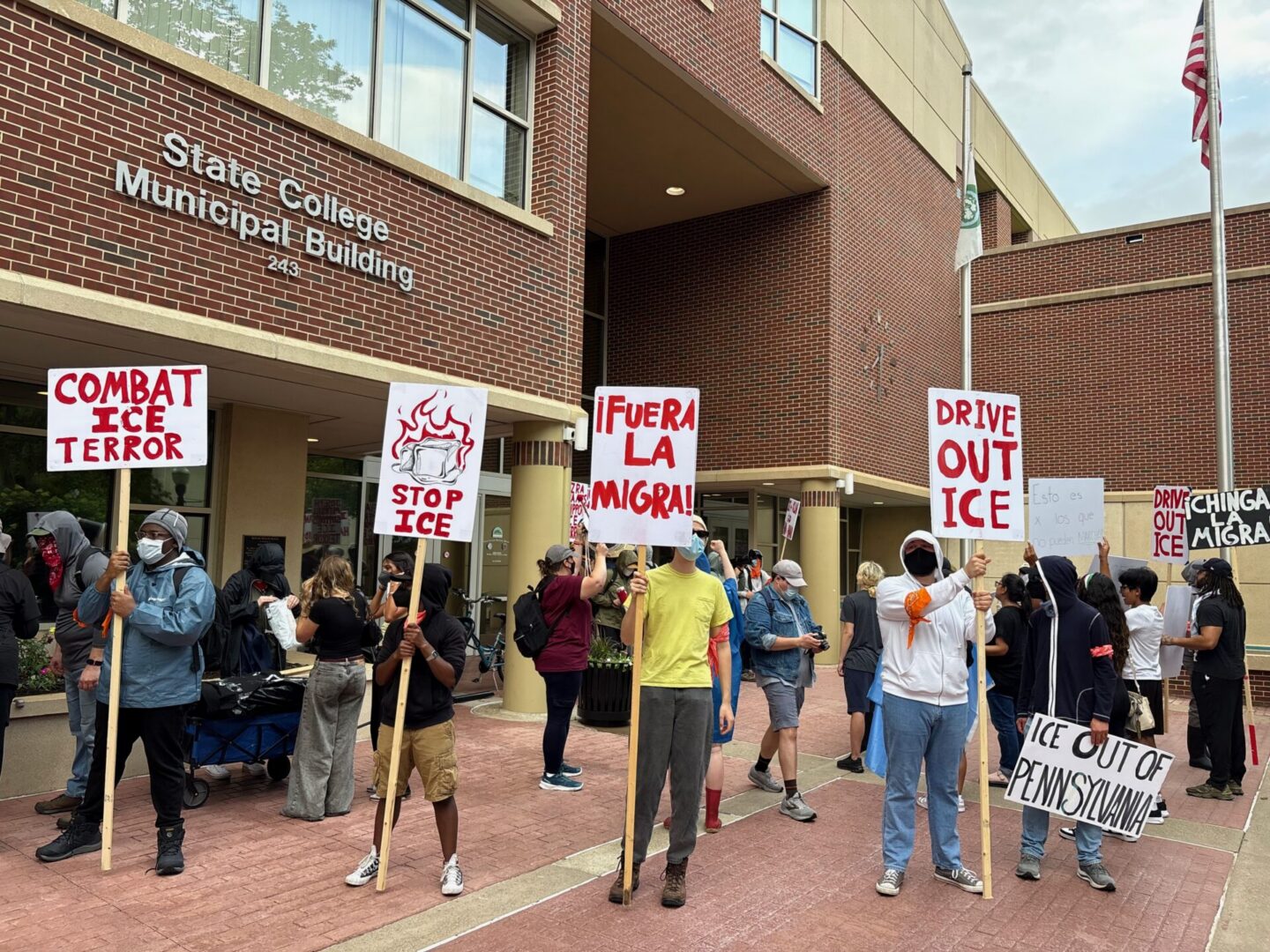
The group continued onto Fraser Street, looped around Beaver Avenue and returned via South Allen Street, where demonstrators gathered outside the municipal building as council met inside.
Many carried signs criticizing ICE and urging the borough to pass a “no collaboration” ordinance. Protesters chanted as they marched through downtown, drawing the attention of pedestrians and motorists.
“We’re out here today telling the borough that we stand with the immigrant workers and their families who are being targeted every single day,” an organizer with People’s Defense Solidarity said before the march.
Throughout the march, several demonstrators, who were acting as the group’s “security,” could be seen moving barriers to block incoming traffic and to create a path for the group.
The protest follows heightened concerns among immigrant advocates after the recent ICE enforcement actions in Centre County, including arrests that prompted demonstrations and renewed calls for local government action.
“Just last weekend, ICE announced that their new daily quota for detention is now 2,000,” the organizer said. “That’s 2,000 community members and workers who are being taken away from our families, our friends and our communities. Some of the workers in State College who have been taken are people who are constructing the hospital. We absolutely will not stand for that.”
People’s Defense Front, which has led similar previous demonstrations, has organized community patrols intended to monitor ICE activity and train residents to identify federal immigration enforcement operations. The group says it has trained 90 community members and hosts around 60 patrols a week.
“Those don’t seem like a lot of numbers, but when you see people come out when people are spotting ICE, it’s very powerful to see the numbers that come out and show up,” the organizer said. “A whole community is coming together to stand up and say this isn’t OK; we’re not going to allow.”
Following the passage of the ordinance, the group plans to continue its training and patrols.
“This is a small win,” the organizer said before the group traveled back down Allen Street to the gates. “It’s going to make their job a little harder because they can’t lean on local resources, but it’s not going to stop ICE from showing up. It’s only going to light a fire under us more and show that people have the power when we stick together.”
Back inside the council meeting prior to the vote, one community member read from a petition that urged the adoption of the ordinance.
“By adopting this policy, State College Borough can send a clear message that we value dignity, fairness and safety for all residents, and that our diversity is a strength of our communities, not something to fear,” she said.